
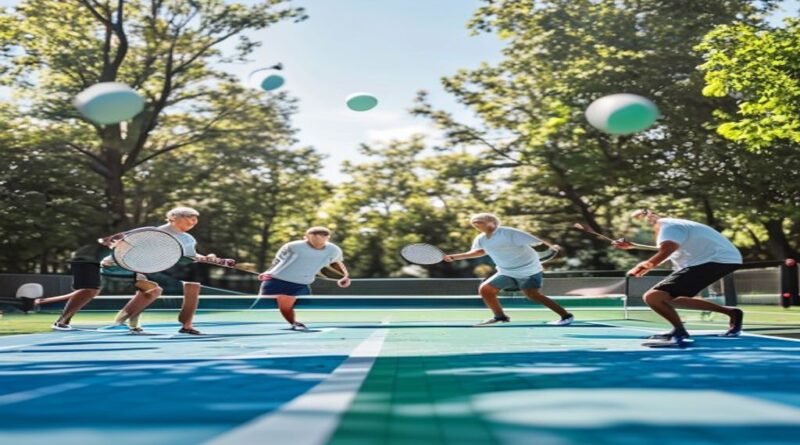
The Kitchen Is Open: Pickleball and the Changing Face of American Recreation
The sound arrives before the explanation. In parks and gyms across America, a distinctive plastic pop-pop-pop has replaced the thud of basketballs and the ping of tennis rallies, and neighbors have learned, sometimes grudgingly, what it means: the pickleball players are here. A game invented in the 1960s by fathers improvising a diversion for restless children on a Pacific Northwest island has become, by nearly every count, the fastest-growing sport in the United States, played by tens of millions of Americans on courts that seem to multiply overnight.
The obvious question is how a game with a silly name and a perforated plastic ball conquered a country full of established sports. The answer has surprisingly little to do with the game itself, and almost everything to do with what modern American life has been missing.
Engineered for Accessibility
Start with the design, which is almost accidentally brilliant. A pickleball court is a fraction of the size of a tennis court, so there is far less ground to cover. The underhand serve removes the single hardest skill in racquet sports. The lightweight paddle is forgiving, and the ball travels slowly enough that beginners can sustain rallies on day one. A no-volley zone near the net, universally known as the kitchen, blunts the advantage of power and youth, pulling the game toward touch, placement, and patience.
The result is a rare species of sport: genuinely multigenerational. A seventy-year-old with good hands can hold her own against her thirty-year-old grandson, and both will get a workout and a laugh. Most sports sort players ruthlessly by athleticism. Pickleball scrambles the sorting, which means nobody has to be embarrassed, and everybody gets to play.
The Loneliness Cure Disguised as a Sport
But accessibility alone does not explain the fervor, the players who show up five mornings a week, the friendships, the tournaments, the courtside potlucks. Public health officials have spent years warning about an epidemic of loneliness in America, particularly among older adults and, increasingly, among the young. Third places, the informal gathering spots that once stitched communities together, have been disappearing for decades.
Pickleball, almost uniquely among modern pastimes, rebuilt one. The game’s culture revolves around open play: show up alone, drop your paddle in a rack, and rotate into doubles matches with strangers. Games are short, so partners shuffle constantly. Within an hour, a newcomer has met a dozen people. Within a month, they have a standing social calendar.
- Matches are short and social, with constant rotation among players.
- Doubles is the default format, making conversation part of the game.
- Open-play customs mean nobody needs to arrive with a partner or a plan.
- The learning curve is gentle enough that beginners are welcomed rather than tolerated.
People come to the court for the exercise. They come back for the people.
Growing Pains in Real Time
Explosive growth has brought genuine friction. The most visible battles are over real estate, as parks departments convert tennis courts and communities argue over who deserves the space. The sport’s signature sound has spawned noise complaints, lawsuits, and a cottage industry of quieter paddles and acoustic fencing. Sports medicine clinics report a wave of pickleball injuries, largely because the game lures long-sedentary adults into sudden lateral movement their bodies have not attempted in years.
There is also an identity struggle underway. Professional tours, celebrity team owners, and serious prize money have arrived, along with carbon-fiber paddles and training academies. Some veterans worry that professionalization will import the elitism and intensity that pickleball’s culture was a refuge from. Whether the sport can be both a competitive industry and a welcoming public square is the defining question of its next decade.
What Pickleball Reveals About the Future of Play
Zoom out, and pickleball looks less like an anomaly and more like a preview. The sports that are growing fastest in America, from pickleball to run clubs to climbing gyms, share a profile: low barriers to entry, built-in social structure, flexible commitment, and room for every age and body type. The sports struggling to hold casual adult participants tend to demand the opposite, long games, fixed teams, high skill floors, and youth-centric cultures.
Americans, in other words, have not lost the desire to play. They have lost patience with recreation that requires excellence as the price of admission. Pickleball’s genius was to lower that price to nearly zero while keeping the things that make sport worthwhile: competition, improvement, laughter, and other people.
The plastic ball and the funny name were never the point. The point is visible at any public court on a Saturday morning, where retirees, teenagers, and young parents rotate through games with people they did not know last month. A country that has spent two decades retreating into screens found, on a badminton-sized rectangle, an excuse to gather again. That pop-pop-pop echoing across American parks is the sound of a game, but it is also the sound of a social fabric, stitch by stitch, repairing itself.
