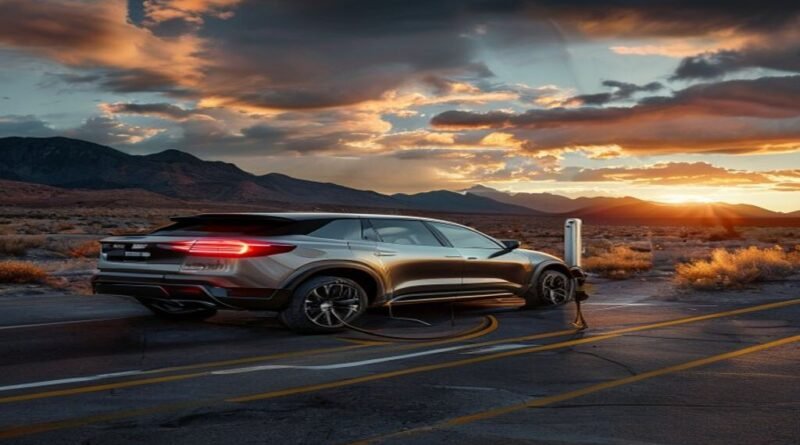
Recharging the Great American Road Trip: Electric Vehicles Meet the Open Road
The American road trip has always been a technology story wearing a romance costume. It took the Model T to invent it, the interstate system to industrialize it, and cheap gasoline to make it a birthright. Now a new machine is renegotiating the ritual. The electric vehicle does not just change what powers the car; it changes the rhythm of the journey itself, the geography of where travelers stop, and the small culture that grows up around those stops. The question wafting through rest areas from Barstow to Bangor is whether the EV road trip is a diminished version of the classic, or simply a different one.
The Anxiety Formerly Known as Range
For years, the conversation began and ended with range anxiety, the fear of rolling to a silent stop on a lonely highway shoulder. That fear made sense when electric cars were niche machines with modest batteries and charging stations were scarce curiosities. The picture has shifted. Mainstream EVs now commonly travel two hundred to three hundred or more miles on a charge, and fast-charging networks have spread along major corridors, aided by federal infrastructure funding and the consolidation of the industry around a common charging connector standard.
Veteran EV travelers will tell you the anxiety does not vanish so much as mature into planning. Where a gasoline driver improvises, the electric driver choreographs. Trip apps calculate charging stops, factor in elevation and headwinds, and reroute around busy stations. The skill resembles sailing more than motoring: you work with conditions rather than ignoring them.
The Thirty-Minute Town
Here is the unexpected part. A fast-charging stop typically takes twenty to forty minutes, long enough that the old gas-station ritual, pay, pump, grab a questionable hot dog, leave, does not fit. Travelers need something to do, and towns are noticing. Chargers increasingly appear beside diners, main-street coffee shops, farmers markets, and trailheads rather than only at highway plazas. The charging stop is becoming a small act of tourism.
The gas station asked nothing of a town but cheap land near an off-ramp. The charging stop asks a town to be worth thirty minutes of a stranger’s time.
This is quietly reshaping road-trip culture. Where the twentieth-century trip celebrated distance conquered per day, the electric trip nudges travelers toward the older, slower ideal: the detour, the local lunch, the scenic overlook you would have blown past at seventy-five miles per hour. Some travelers resent the imposition. Others report that being forced to stop is the best thing that ever happened to their vacations.
What Still Needs Fixing
Honesty requires acknowledging the friction. The EV road trip remains easiest for people driving popular corridors between major cities, and hardest across the rural stretches of the Great Plains and Mountain West, where chargers can be sparse and a single broken station matters. Reliability has been the industry’s persistent embarrassment: arriving at a charger that is offline, blocked, or crawling at reduced speed is the modern equivalent of the boarded-up gas station. Other pain points travelers consistently cite include:
- Charging speeds that slow significantly in extreme cold, stretching winter travel times.
- Uneven pricing and a maze of apps and memberships, though plug-and-charge payment is spreading.
- Long waits at busy stations on holiday weekends, when demand spikes outpace capacity.
- Limited options for drivers towing trailers or boats, since towing can cut range dramatically.
None of these problems is exotic; all are the ordinary growing pains of infrastructure. The interstate highway system itself took decades to knit together, and early motorists carried spare fuel cans and patch kits as a matter of course. The EV era is in its patch-kit years.
The Economics of the Long Haul
For all the talk of hardship, the arithmetic often favors electrons. Charging costs vary widely, but road-trippers who charge overnight at hotels or campgrounds, where electricity is cheap or bundled, can cross states for a fraction of the cost of gasoline. Hotels have discovered that a bank of chargers in the parking lot is a genuine amenity, filtering in guests the way free breakfast once did. Meanwhile, the driving itself wins converts: instant torque up mountain grades, near silence through national parks, and no idling fumes at the trailhead.
The Road Ahead
The great American road trip has survived every technology thrown at it, from the automatic transmission to the smartphone that killed the paper map. It will survive the battery too, and may even be improved by it. The trip has always been less about the machine than about the peculiar national conviction that freedom is something you drive toward, with the windows down and the horizon open.
What the electric vehicle changes is the tempo. It swaps the sprint for something closer to a series of strolls, punctuated by coffee in towns you would never have met. Somewhere between the fast charger and the diner counter, a new generation of travelers is discovering what the old two-lane romantics always claimed: the stopping is not an interruption of the journey. It is the journey.
