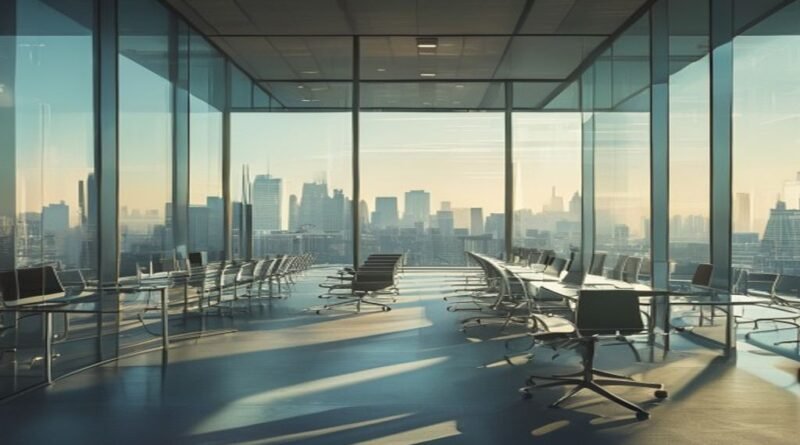
The Empty Tower Problem: How Remote Work Reshaped the American Office Economy
For most of the twentieth century, the American office was less a place than a gravitational field. It pulled millions of workers into downtowns each morning, and around that daily tide grew an entire ecosystem: commuter railroads, parking garages, lunch counters, dry cleaners, shoeshine stands, and after-work bars. Then, almost overnight, the tide stopped coming in. The mass experiment in remote work that began as an emergency measure hardened into a lasting arrangement, and the economy built around the commute has been adjusting ever since.
The New Geography of the Workday
The most visible change is where work happens. Hybrid schedules have become the default for a large share of white-collar employers, with midweek days in the office and Mondays and Fridays at home. Fully remote arrangements persist in technology, finance, media, and professional services, and they have quietly enabled a migration of talent away from the most expensive coastal metros toward smaller cities and suburbs.
This dispersal moved spending along with it. The dollars that once flowed to a downtown salad chain now go to a neighborhood coffee shop; the transit fare became a home utility bill. Economists describe it as the doughnut effect: activity hollowing out of central business districts and thickening in the residential ring around them. Suburban main streets, once sleepy on weekdays, have found unexpected new life.
Commercial Real Estate’s Long Reckoning
Nowhere is the disruption more acute than in office real estate. Vacancy rates in many major markets have hovered at levels not seen in decades, and older buildings with dated layouts and poor light have suffered most. Landlords face a slow-motion squeeze: leases signed before the pandemic expire year by year, and tenants renew for less space, better space, or not at all.
The consequences ripple outward. Office towers secure billions in loans, and when appraised values fall, the pain reaches regional banks, pension funds, and insurers that hold the debt. Some owners have surrendered buildings to lenders rather than refinance at higher interest rates. Meanwhile, a flight to quality has split the market in two: gleaming, amenity-rich towers still command premium rents, while commodity buildings from the 1970s and 1980s struggle to attract anyone at any price.
- Trophy offices with gyms, terraces, and hospitality-style service remain in demand as employers try to make commuting worthwhile.
- Older Class B and C buildings face conversion, redevelopment, or prolonged vacancy.
- Office-to-residential conversion is promising but hard, since deep floor plates and plumbing layouts often make apartments impractical without major surgery.
City Budgets Feel the Squeeze
American downtowns are not just business districts; they are tax engines. Commercial property taxes, transit fares, parking revenue, and sales taxes from lunchtime spending fund schools, police, and social services. When office values fall and foot traffic thins, city halls feel it. Budget officials in major metros now openly discuss a fiscal doughnut to match the economic one, and transit agencies that depend on fare revenue have faced repeated funding cliffs as ridership settles below pre-pandemic norms.
A downtown built for 9-to-5 occupancy must now earn its visitors, competing for people who have a perfectly good office at home.
The cities adapting fastest are treating the crisis as a design problem. They are streamlining conversions of obsolete offices into housing, courting universities, health systems, and labs to fill empty floors, and programming streets with markets, festivals, and nightlife to give people reasons to show up that have nothing to do with a badge swipe.
What Employers Learned the Hard Way
Inside companies, the great remote-work experiment produced a more complicated verdict than either evangelists or skeptics predicted. Productivity held up better than doomsayers feared for focused, individual tasks, while collaboration, mentorship, and onboarding proved genuinely harder at a distance. Younger employees, ironically among the most enthusiastic about flexibility, often lose the most when offices empty out, missing the apprenticeship that happens through proximity.
The emerging consensus treats the office as a tool rather than a default. Firms are shrinking their footprints but upgrading what remains, swapping rows of desks for meeting space, event space, and places designed for the human contact that video calls cannot replicate. Attendance policies keep evolving, but few leaders expect a full return to five mandatory days. Flexibility has become part of compensation, and clawing it back carries a real price in retention.
An Economy Still Finding Its Shape
The office is not dying; it is being renegotiated. What has ended is the assumption that white-collar work must happen in a specific tower between specific hours. The adjustment will take years to play out in lease expirations, loan maturities, and city budgets, and it will create losers as well as winners. But it is also a rare chance to rebuild downtowns around people rather than commuters, and to let millions of workers reclaim hours once spent in traffic. Economies are resilient precisely because they reorganize around new realities. The American office economy is doing exactly that, one hybrid schedule and converted tower at a time.