
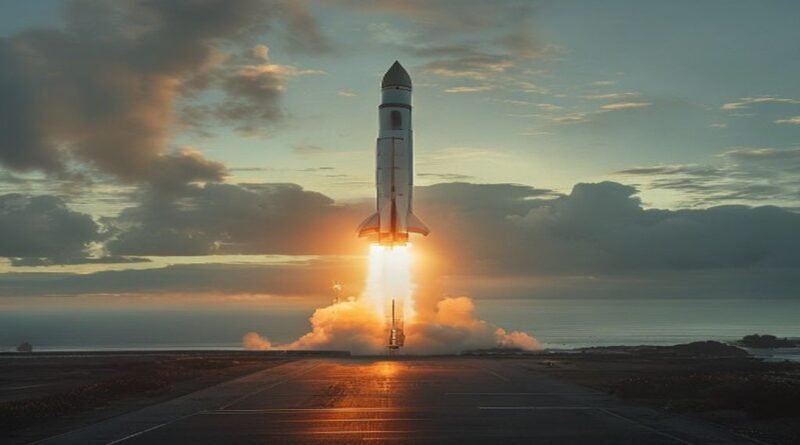
Back to Earth: Why SpaceX’s Blockbuster IPO Just Slipped Below Its Launch Price
A month ago, getting a piece of SpaceX was the hottest ambition on Wall Street — the retail-investor equivalent of a ticket to the moon. On Wednesday, for the first time since Elon Musk’s rocket company went public in June, the stock closed the gap with reality: shares slipped beneath their $135 offering price, trading down to around $133 before clawing back, as TechCrunch reported. For a listing that was supposed to mint a new class of space-age fortunes, the symbolism was hard to miss. The rocket still flies. The stock, for now, does not.
The Hottest Listing of the Decade
The scale of SpaceX’s June 12 debut is worth pausing on, because it explains the intensity of the reversal. The offering raised nearly $86 billion, per TechCrunch, and in the euphoric first days of trading the shares rocketed past $200 — Yahoo Finance put the early surge at nearly 50 percent in the first three sessions — briefly giving the company a market value that rivaled Amazon and Microsoft. Index committees moved at unusual speed: the stock was folded into the Russell 1000 within weeks and into the Nasdaq 100 after a rule change accelerated eligibility for newly public giants, according to Yahoo Finance.
It was, in other words, priced not as a rocket company but as a piece of the future itself. That is a hard thing to live up to on a weekly earnings-and-headlines cycle.
A Month of Slow Descent
What followed the peak was not a crash but an erosion — a stock drifting lower nearly every week, as TechCrunch described it, with the bonds SpaceX sold after the IPO sagging alongside. Part of the story is structural. Only about 4 percent of the company’s shares actually trade on the Nasdaq, a sliver of a float that TechCrunch notes makes every wave of enthusiasm or doubt hit the price harder than it would at an ordinary company. When the most-watched stock in America is also one of the thinnest-traded large caps, volatility isn’t a bug; it’s the operating condition.
What’s Weighing on the Rocket Maker
The pressures that finally pushed the shares below their launch price are a mix of company-specific facts and market-wide mood, as reported by Yahoo Finance:
- Red ink at altitude: The company disclosed a $4.9 billion net loss for the previous year — a reminder that building Starships and blanketing the sky with satellites consumes cash on a scale few businesses ever have.
- The Fed factor: Uncertainty over the Federal Reserve’s interest-rate path has made long-duration bets — companies whose profits live far in the future — less fashionable across the board.
- The AI hangover question: Growing doubts about the durability of the rally in AI-linked stocks have cooled the broader appetite for story-driven tech names.
- The lockup clock: An expiration of insider lockup restrictions looms after the company’s coming quarterly earnings, an event that typically adds selling pressure as early holders gain the freedom to cash out.
None of these is fatal, and Yahoo Finance notes that Wall Street analysts have largely remained bullish on the company despite the slide. But together they have accomplished what gravity always does eventually: they brought the price back toward the point of departure.
The Starship Wild Card
Hanging over all of it is Thursday’s scheduled Starship launch — the first since a booster failure in May, per TechCrunch. This test is designed without recovery attempts; both the booster and the upper stage are meant to end their flights in the Gulf of Mexico. That is normal for a vehicle still deep in development, but it captures SpaceX’s new predicament as a public company. As a private firm, a fiery test was a data point. As a stock, every launch is now also an earnings event, graded in real time by shareholders who may not share an engineer’s affection for instructive explosions.
A Test of Wall Street’s Patience
The deeper question raised by SpaceX’s first month is whether the public markets can hold two ideas at once: that this is arguably the most consequential aerospace company of its era, and that consequence takes decades to monetize. TechCrunch framed the slide as markets “sobering up” to the promises made around the listing — which may be less an indictment than a normalization. Amazon spent years below its dot-com peak before becoming Amazon. Whether SpaceX follows that arc, or whether the sky-high expectations of June prove to be the anomaly, is the story the next several quarters will tell — starting with a rocket over the Gulf on Thursday afternoon.
For the millions of ordinary investors who bought in during those first breathless days — many making their first-ever stock purchase — the past month has been a compressed education in what owning a piece of the future actually feels like. It is rarely a straight line up. It is a long, jagged argument between a company’s ambitions and a market’s attention span, and it has only just begun.
This article is for informational purposes only and does not constitute investment advice.
