
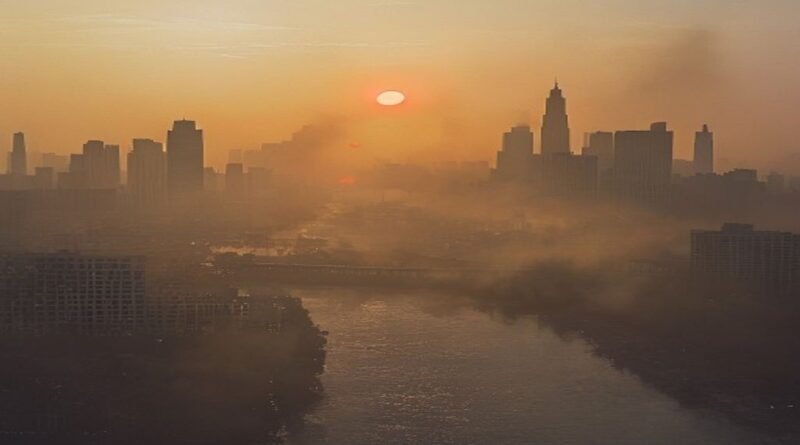
A Sky the Color of Rust: Canada’s Wildfire Smoke Settles Over the American Summer
The sun over Duluth this week rose the color of a dying ember, and by Wednesday afternoon the same strange light was sliding down the Eastern Seaboard. It is becoming a grim rite of the American summer: somewhere far to the north, forests burn, and days later, tens of millions of people from the Great Lakes to the Atlantic find themselves squinting through a sky the color of rust, checking an air-quality app they didn’t know they had. This week’s version is one of the larger ones — and it arrived in the middle of a stretch of dangerous heat.
Where the Smoke Is Coming From
The source is a wildfire outbreak of startling scale. More than 830 wildfires were burning across Canada as of Wednesday, with the largest concentrated in west-central Ontario, many of them growing with little or no containment and forcing mandatory evacuations, ABC News reported. The fire map does not stop at the border: in northern Minnesota, the Camp Fire in Lake County jumped its containment lines on Monday and triggered evacuations of its own, according to FOX Weather, which also reported that Ontario logged 32 new fires in a single day, with 46 burning out of control.
Smoke is indifferent to geography in a way people are not. What burns in a remote stretch of Ontario becomes, seventy-two hours later, a public-health advisory in Philadelphia.
From the Great Lakes to the I-95 Corridor
The plume moved in stages. Very heavy smoke settled first over Duluth, Minnesota, and Marquette, Michigan, with northern Wisconsin under some of the thickest bands — conditions ABC News said could rank among the worst air quality in the world by Thursday in the Duluth-to-Marquette corridor. Air quality alerts stretched across Minnesota, Wisconsin and Michigan before extending east into New York.
By Wednesday afternoon the smoke had reached the great population centers of the Northeast, arriving over the New York City–to–Boston corridor, with Buffalo, Philadelphia, Cleveland, Columbus, Baltimore and Washington, D.C., all in its path, per ABC News. FOX Weather’s forecasters put the stakes plainly:
“Under the thickest bands of the plume, reduced visibilities are possible, and air quality will likely become very unhealthy if the latest computer forecast models are correct.”
All of this is unfolding against a punishing weather backdrop — highs near triple digits and severe thunderstorm risk in parts of the Northeast this week — the kind of compound misery in which the usual advice to “just stay inside” does real logistical damage to ordinary life: youth sports, outdoor work, summer camps, evening runs.
What “Unhealthy for Everyone” Really Means
The language of air-quality warnings can blur together, but this event carries an unusual edge. ABC News noted the smoke may reach levels dangerous for everyone — not just children, older adults and people with asthma or heart and lung conditions, the groups who normally bear these advisories alone. In Minnesota, the state’s Pollution Control Agency advised residents to avoid prolonged outdoor activity, per FOX Weather.
It helps to know what the color-coded scale is actually measuring. The Air Quality Index runs from green (good) through orange (unhealthy for sensitive groups) to red, purple and maroon, and events like this one can push readings into ranges most Americans east of the Rockies rarely see. A red or purple day is not an aesthetic judgment about the haze; it is a measurement of how much of that haze ends up inside your lungs.
Wildfire smoke’s signature pollutant is fine particulate matter — particles small enough to slip past the body’s defenses and into the bloodstream. The practical playbook is unglamorous but effective: watch the local Air Quality Index, move exercise indoors on the worst days, close windows, run air conditioning or a HEPA-grade purifier if available, and treat an N95-style mask as reasonable equipment for anyone who must work outside under a thick plume.
A Pattern That Keeps Returning
If this feels familiar, it should. Smoke events that once counted as generational oddities — the kind that turned New York’s skyline sepia in 2023 — have become a semi-regular feature of the northern summer, as Canadian fire seasons grow longer and more volatile. Each episode follows the same arc: alarming photographs of a red sun, a few days of canceled ballgames and raspy throats, then a merciful wind shift and collective amnesia until the next one. The infrastructure of American summer — built around the assumption of breathable outdoor air from May to September — is quietly being renegotiated, one plume at a time.
When Relief Arrives
There is, at least, an exit ramp in the forecast. Rain is expected to begin scrubbing the air over the Upper Midwest on Friday, with showers reaching the Northeast by Saturday, according to ABC News — a reminder that in smoke events, weather is both the villain and, eventually, the rescue. Until then, the sensible course is the boring one: check the AQI the way you check the temperature, keep the strenuous stuff indoors, and give a thought to the firefighters and evacuees on the other end of this plume, for whom the haze over Manhattan is the least of what those 830 fires have taken.
